Perhaps your forehead has been a lifelong insecurity, or you have never felt confident wearing your hair off your face. Most people who feel this way are worrying without ever knowing the actual standard: is my forehead objectively big, or does it just feel that way?
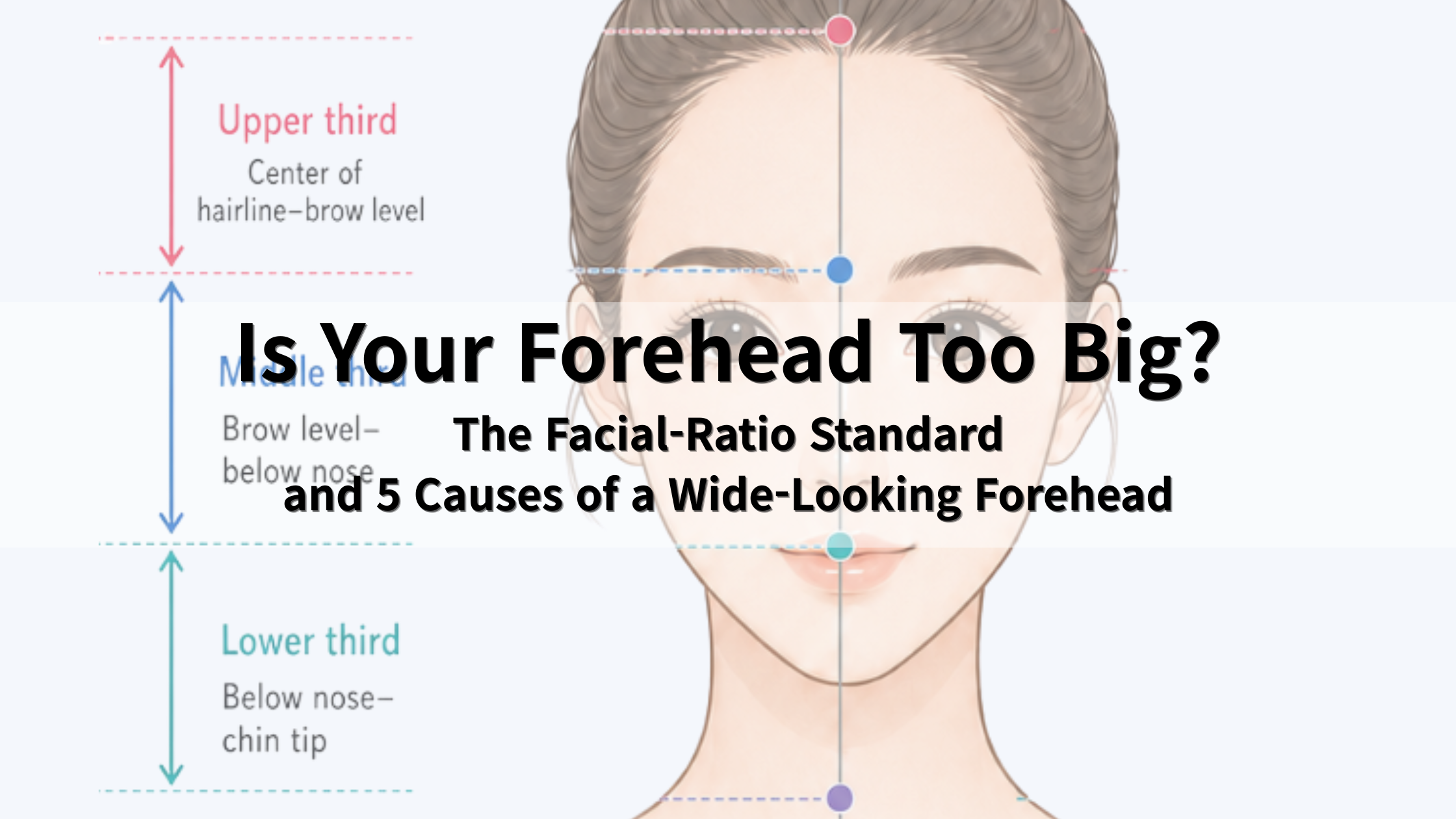
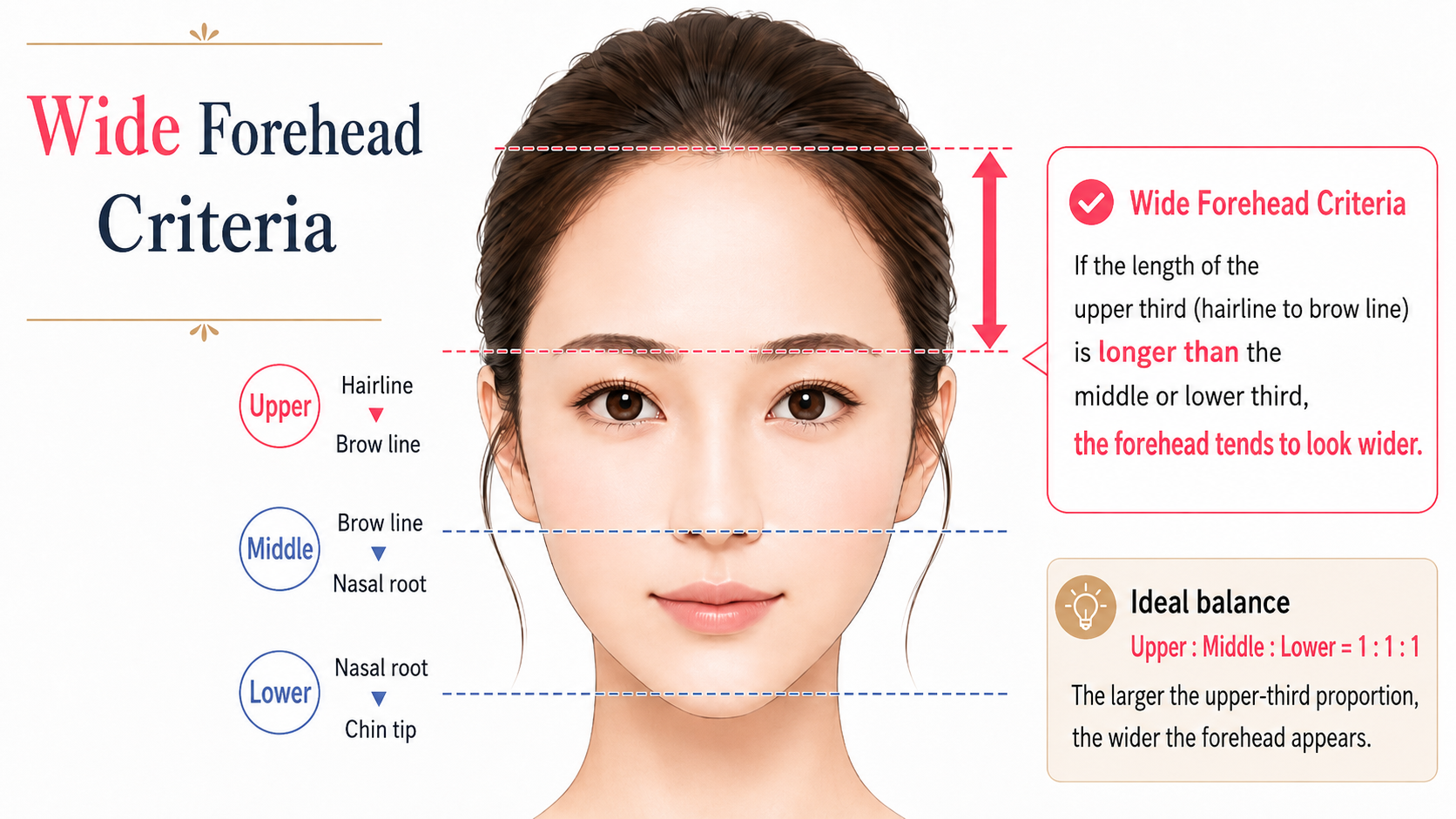
The short answer: forehead size can be measured objectively, not by feel but by its ratio to the rest of the face. The commonly cited guideline for a balanced face divides it vertically into thirds: upper (hairline to brows), middle (brows to the base of the nose), and lower (base of the nose to chin), sitting in a ratio of roughly 0.9-1 : 1 : 0.8-0.9. In other words, a forehead looks harmonious when it is about the same length as the midface, or just slightly shorter.
And the hairline's position is not the only reason a forehead looks big. Three elements are involved: the hairline, the skull (the shape of the forehead bone), and the face type, and the right improvement differs by cause. This article walks through a one-minute measurement, the five cause types, and the improvement options for each.
The 1-Minute Forehead Self-Measurement
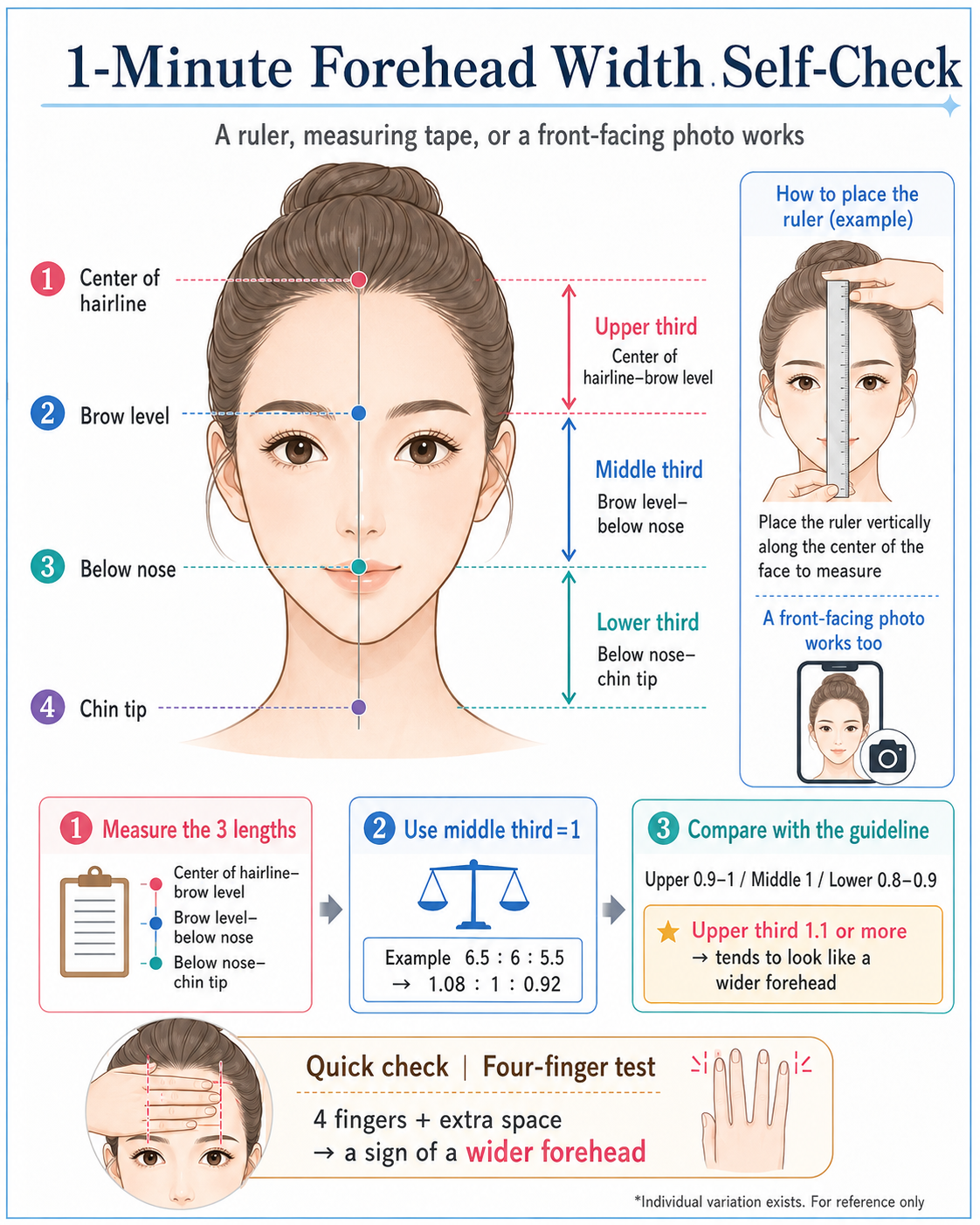
Step 1: Measure three lengths. Facing forward with your bangs lifted, measure the vertical length of these three sections: upper face, from the center of the hairline to the height of the inner brow; midface, from the inner brow to the base of the nose; lower face, from the base of the nose to the tip of the chin.
Step 2: Set the midface to "1" and calculate the ratios. Using the midface length as the baseline (= 1), work out what multiple the upper and lower sections are. For example, upper 6.5 cm, middle 6 cm, lower 5.5 cm gives roughly 1.08 : 1 : 0.92.
Step 3: Compare against the guideline. The balanced guideline is upper 0.9-1 : middle 1 : lower 0.8-0.9. If your upper-face value clearly exceeds 1 (for example, 1.1 or more), the forehead occupies a large share of the face, which tends to read as "a big forehead."
Quick version: the four-finger test. No ruler? Lay your fingers horizontally just above your brows. If all four fingers, index to pinky, fit with room to spare, that is a rough indicator of a wider forehead (finger width varies by person, so treat this as reference only).
The Standard for "Too Big": The Ideal Forehead by Ratio
The vertical balance of the face has long been evaluated by dividing it into thirds, a classical framework for facial proportion. The baseline idea is that the face looks harmonious when the three sections are roughly equal; in practice, the proportions generally considered most attractive have a slightly shorter lower face (0.8-0.9) and an upper face equal to or slightly shorter than the midface (0.9-1).
The point is that forehead size is decided not by an absolute number of centimeters but by its ratio to the whole face. The same 6.5 cm forehead can sit comfortably within balance on a longer face, yet dominate a smaller face. The accurate judgment is not "it feels bigger than my friend's" but the ratio within your own face.
One more thing: falling outside the guideline does not equal needing treatment. For many people, a generous forehead is exactly what reads as intelligent or striking. Use the ratio purely as a yardstick for understanding, objectively, how big the forehead you are worried about actually is.
The 5 Causes of a Wide-Looking Forehead: Hairline, Skull, and Face Type
Type 1: A naturally high hairline. Determined by the inborn position of the bone structure and hair line; the forehead has been consistently big since childhood. The ratio measurement shows a clearly long upper face.
Type 2: A receding hairline. If the forehead feels bigger than it used to be, the hairline may be receding. Causes include male- and female-pattern hair loss (AGA/FAGA) as well as traction alopecia from years of tightly pulled hairstyles such as ponytails. The critical question for this type is whether the recession is still progressing: reposition the hairline while it is still receding, and the result is undone as it recedes again. A hair diagnosis at a dermatology or specialist clinic comes first.
Type 3: The hairline's shape makes it look big. Even when the area itself is moderate, a squared-off hairline, an M-shaped notch, or a jagged line makes the forehead read as wide and irregular. Here the issue is shape rather than size, so hairline design becomes the focus.
Type 4: The skull (forehead bone) makes it look big. When the forehead bone projects forward or has a strong curve, the forehead can look large in three dimensions even with a standard hairline position. The forehead is a curved surface, not a flat one, so at the same vertical length measured from the front, a rounder bone means more visible forehead area. For this type, moving the hairline alone may not fully change the impression, and a diagnosis that includes the bone's curvature is needed.
Type 5: Face type and perception. Cases where the forehead looks bigger than it is because of its relationship to the face type (round or long) or because of a parting habit or thin bangs. Someone with a compact facial width, for instance, will find the same forehead's vertical size more emphasized. If your ratio falls within the guideline, a hairstyle adjustment alone may change the impression dramatically.
The Limits of Self-Measurement, and What a Proper Diagnosis Adds
The ratio tells you the degree of size, but choosing an improvement requires assessments that no self-check can make.
The state of the hairline's hair (whether recession is progressing, the degree of miniaturized hairs; the key to Type 2). Scalp laxity (how far the hairline can be lowered in forehead reduction surgery depends on how much the scalp stretches). The forehead bone's structure and curve (it shapes the three-dimensional result when the line is lowered; the key to Type 4). And the balance with the whole face (the optimal hairline differs person to person relative to the brows and eyes).
How your own ratio measures up, how many centimeters of lowering would be appropriate if you chose to, or whether a shape adjustment alone would suffice: a diagnosis answers all of it objectively. Start with a free consultation for measurement and diagnosis. 【要差し替え|予約ページのリンクを設定してください】
The Improvement Map by Cause Type
Besides forehead reduction surgery (hairline lowering), hairline hair transplantation is another way to bring the hairline down. Which suits you depends on the cause type and the state of your hair and scalp.
Frequently Asked Questions
Q1. If four fingers fit on my forehead, is it "too big"?
A. The four-finger test is a rough shortcut only. Finger width and face size vary by person, so for an accurate answer, use the facial-thirds ratio in this article (upper 0.9-1 : middle 1 : lower 0.8-0.9).
Q2. What is the average forehead height in centimeters?
A. Hairline to brow is often cited at around 6 cm, but what matters is not the absolute value; it is the ratio to your whole face. The same length reads differently depending on the face's vertical proportions.
Q3. Are there ways to fix a big forehead other than hairstyles?
A. Two methods change the hairline's actual position: forehead reduction surgery (incising and lowering the hairline) and hairline hair transplantation. Which fits you depends on your cause type and the condition of your hair and scalp, so choose after a diagnosis.
Q4. Can I book a consultation just to be measured?
A. Yes. At Respect Plastic Surgery, consultations are free (allow about 1 to 2 hours), and depending on the measurement and diagnosis, you may be advised of non-surgical options, or simply told that your current balance is fine as it is. 【要確認|無料・所要時間・運用方針の記載は院内の実際の運用と照合してください】
Conclusion
Forehead size is measured accurately not as an absolute value but by the facial-thirds ratio (guideline: upper 0.9-1 : middle 1 : lower 0.8-0.9). The method takes about a minute: measure hairline-to-brow, brow-to-nose-base, and nose-base-to-chin, then set the midface to 1. A wide-looking forehead comes down to five cause types, the natural hairline position, hairline recession, an irregular shape, the skull's curve, and face type and perception, each with a different fix. If recession is suspected, a hair diagnosis comes before any reduction or transplant. And how far the hairline can be lowered (scalp laxity) and the optimal line including the bone are things no self-check can determine; they require a professional diagnosis.
Where your forehead sits by ratio, and which method would suit you if you chose to improve it, becomes clear once you are measured and diagnosed. There is no hard selling; treat it simply as a first step toward knowing where you stand.

 Google Maps