

Concept: woman looking in a mirror, concerned that her philtrum looks long; central facial line subtly highlighted
alt: woman concerned that her philtrum looks long
Suggested filename: philtrum-nose-guide-hero.jpg
Have you ever looked in the mirror and felt that your philtrum, the area between your nose and upper lip, looks long from the front? Most people assume this concern can be solved with philtrum shortening (a lip lift) alone. In reality, however, the perceived length of the philtrum is deeply connected to the shape of the nose. If you shorten only the philtrum without looking at the nose, the change may fall short of expectations, or the result may even look unnatural. Philtrum-Nose, the approach proposed by Respect, treats the philtrum and the nose as one unit: it analyzes and corrects the nasal line, meaning the bridge and tip, together with the nasolabial angle at the same time. This article explains what Philtrum-Nose is and why rhinoplasty and nasolabial angle correction are performed together.
The Short Answer: Philtrum-Nose at a Glance
The sections below explain the concept, the anatomy behind it, and how the right plan is chosen.
What Is Philtrum-Nose?
Concept: the philtrum and nose treated as a single unit; one frame enclosing the entire central line from nasal bridge to tip to philtrum to upper lip
alt: concept diagram of the philtrum and nose viewed as one continuous unit
Suggested filename: philtrum-nose-guide-concept.jpg
Philtrum-Nose is Respect's original combined-rhinoplasty philosophy that views the philtrum and the nose as one continuous unit, analyzing and correcting how the philtrum looks from the perspective of the nasal line and the nasolabial angle.
Conventional philtrum shortening physically shortens the philtrum by removing skin just below the nose. It is a valid option, but it rests on one assumption: that the philtrum looks long because the philtrum skin itself is long. Philtrum-Nose reframes the question. Where does the long appearance actually come from? Are the direction and height of the nasal tip, or the line of the bridge, influencing how the philtrum looks? Is the angle formed by the nose and the upper lip appropriate? In other words, Philtrum-Nose designs the balance of the entire central line from the nose to the mouth, rather than treating the philtrum alone.
Why Is Philtrum Length Related to the Nose?
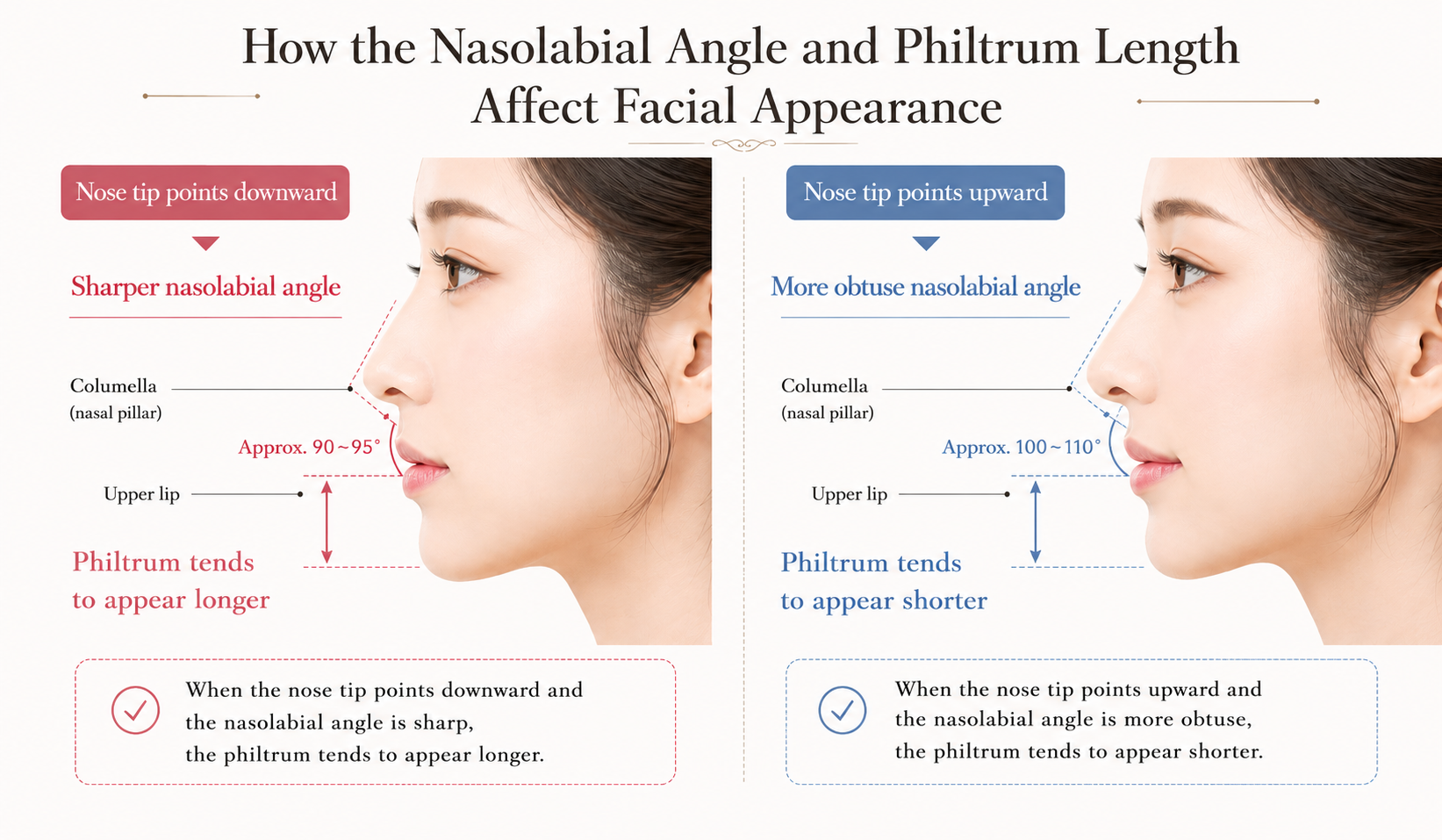
Concept: side-by-side profile diagrams comparing an acute (closed) nasolabial angle with a gently open one, showing how each changes the apparent philtrum length
alt: comparison diagram of the nasolabial angle and how the philtrum appears
Suggested filename: philtrum-nose-guide-angle.jpg
The key is the nasolabial angle: the angle formed between the columella (the central pillar beneath the nasal tip, between the nostrils) and the upper lip. Whether this angle is acute (closed) or gentle (open) dramatically changes the impression of the central face.
When the nasal tip droops downward and the nasolabial angle is acute, the tip appears to hang over the upper part of the philtrum, the midface looks stretched, and the philtrum tends to look longer than it actually is. When the tip is moderately upturned and the angle opens gently, space is created between the tip and the upper lip, and the philtrum tends to look shorter and cleaner.
A philtrum of exactly the same length can look long or short depending on the direction of the nasal tip and the nasolabial angle. That is why philtrum concerns should first be examined from the nose. If your tip droops or your nasolabial angle is acute, shortening the philtrum alone may leave the balance with the nose unresolved, and the change in impression may be smaller than expected.
What Is Nasolabial Angle Correction?
Concept: cross-section and profile views of the nose with arrows marking tip plasty, tip elevation, and columella adjustment
alt: diagram of the approaches used in nasolabial angle correction
Suggested filename: philtrum-nose-guide-approach.jpg
Nasolabial angle correction is the collective term for procedures that adjust the direction and height of the nasal tip to refine the angle between the columella and the upper lip. It typically combines tip plasty (refining the shape and direction of the tip), tip elevation (moderately lifting a downward-pointing tip), and columella adjustment (refining the position and angle of the columella).
Opening the nasolabial angle gently moves the tip an appropriate distance away from the upper lip, and as a result the philtrum can be expected to look cleaner and shorter. Within Philtrum-Nose, nasolabial angle correction is positioned as a key means of changing how the philtrum appears. Note that the appropriate angle varies by individual, depending on gender, bone structure, and overall facial balance. It is not a matter of "the higher the better"; what matters is designing an angle that suits each person's features.
Why Rhinoplasty and Nasolabial Angle Correction Are Performed Together
There are three clear reasons why Respect combines the two in Philtrum-Nose.
1. The cause of philtrum concerns often lies on the nose side. A long-looking philtrum is frequently caused by a drooping nasal tip or an acute nasolabial angle. If the cause lies with the nose, correcting the nose is the fundamental solution.
2. The bridge, tip, and nasolabial angle all influence one another. Lifting the tip changes how the bridge reads, and refining the bridge changes the balance with the tip. Moving only one part disrupts the harmony of the whole, so the entire nasal line needs to be handled as a single design.
3. A single design resolves the balance completely. When rhinoplasty and nasolabial angle correction are planned separately, a mismatch can emerge later between the nose and the mouth area. Analyzing and designing both together from the start allows the central line from nose to mouth to be finished with one consistent balance.
Making the philtrum look shorter by refining the nose, rather than cutting the philtrum, is the core idea behind Philtrum-Nose.
Who Is Philtrum-Nose Suited For?
Concept: checklist-style image summarizing who Philtrum-Nose suits (also reusable for social sharing and saving)
alt: checklist of who is suited to Philtrum-Nose rhinoplasty
Suggested filename: philtrum-nose-guide-checklist.jpg
Philtrum-Nose may suit you if: you are bothered by a philtrum that looks long; you have considered philtrum shortening but are unsure it is truly right for you; you have been told your nasal tip droops or your nasolabial angle is acute; you want the balance of your nose and mouth refined as a whole; or you want to improve not only your front view but also your profile.
On the other hand, there are cases where philtrum shortening is the appropriate choice, such as when the philtrum skin itself is clearly long. Which approach is right can only be determined through an actual examination that assesses the nose, the philtrum, and the balance of the entire face.
The Analysis and Diagnosis Process
Respect's Philtrum-Nose does not start from a predetermined procedure; it starts from analyzing the cause. The flow is as follows. First, a consultation to hear your concerns and the impression you want to achieve. Second, an analysis of the nose-to-mouth line, evaluating the bridge, tip direction, nasolabial angle, and philtrum length comprehensively. Third, isolating the cause: determining whether the philtrum's appearance originates on the nose side or the philtrum side. Fourth, a design proposal presenting the optimal plan, whether a combination of rhinoplasty and nasolabial angle correction, or philtrum shortening. Because the method is chosen according to the cause, not everyone ends up with the same procedure.
Frequently Asked Questions
Q1. How is Philtrum-Nose different from philtrum shortening (a lip lift)?
A. Philtrum shortening physically removes skin below the nose to shorten the philtrum itself, based on the premise that the skin is long. Philtrum-Nose first asks why the philtrum looks long, and when the cause lies on the nose side, it makes the philtrum look shorter by correcting the nasal tip and nasolabial angle instead. The two are not rivals; the right choice depends on where the cause lies, and in some cases philtrum shortening remains the better option.
Q2. Is a more upturned nasal tip always better?
A. No. The appropriate nasolabial angle differs by gender, bone structure, and overall facial balance, and over-rotating the tip can look unnatural. The goal of Philtrum-Nose is not to maximize the angle but to design the angle that suits each individual face.
Q3. Will I know which approach fits me before deciding on any procedure?
A. Yes. The process begins with analysis and diagnosis, not with a fixed procedure. The examination isolates whether the cause is on the nose side or the philtrum side, and the plan, whether rhinoplasty with nasolabial angle correction or philtrum shortening, is proposed based on that finding. You can undergo the analysis first and take time to consider the proposal.
Conclusion
Philtrum-Nose is Respect's combined-rhinoplasty philosophy that analyzes and corrects the nasal line and the nasolabial angle together rather than viewing the philtrum in isolation. A long-looking philtrum is often caused by a drooping nasal tip or an acute nasolabial angle, and correcting the tip's direction and angle can make the philtrum look cleaner and shorter. That is why designing rhinoplasty and nasolabial angle correction together is the most direct route to balancing the nose-to-mouth area. If your philtrum bothers you, start by finding out where the cause actually lies through a proper examination.
Related Articles (Philtrum-Nose Cluster)
Philtrum-Nose vs. Philtrum Shortening: What Is the Difference, and Which Is Right for You?
What Is the Nasolabial Angle? The Ideal Angle and How It Shapes Your Look
Why Your Nasal Tip Looks Droopy and How to Improve It
Philtrum-Nose Downtime and Recovery Timeline
This article is a general explanation of the procedure and does not guarantee results. Suitability and outcomes vary by individual; please confirm details through a physician's examination and consultation. Before publication, review all expressions for compliance with the medical advertising regulations of the target market.

 Google Maps