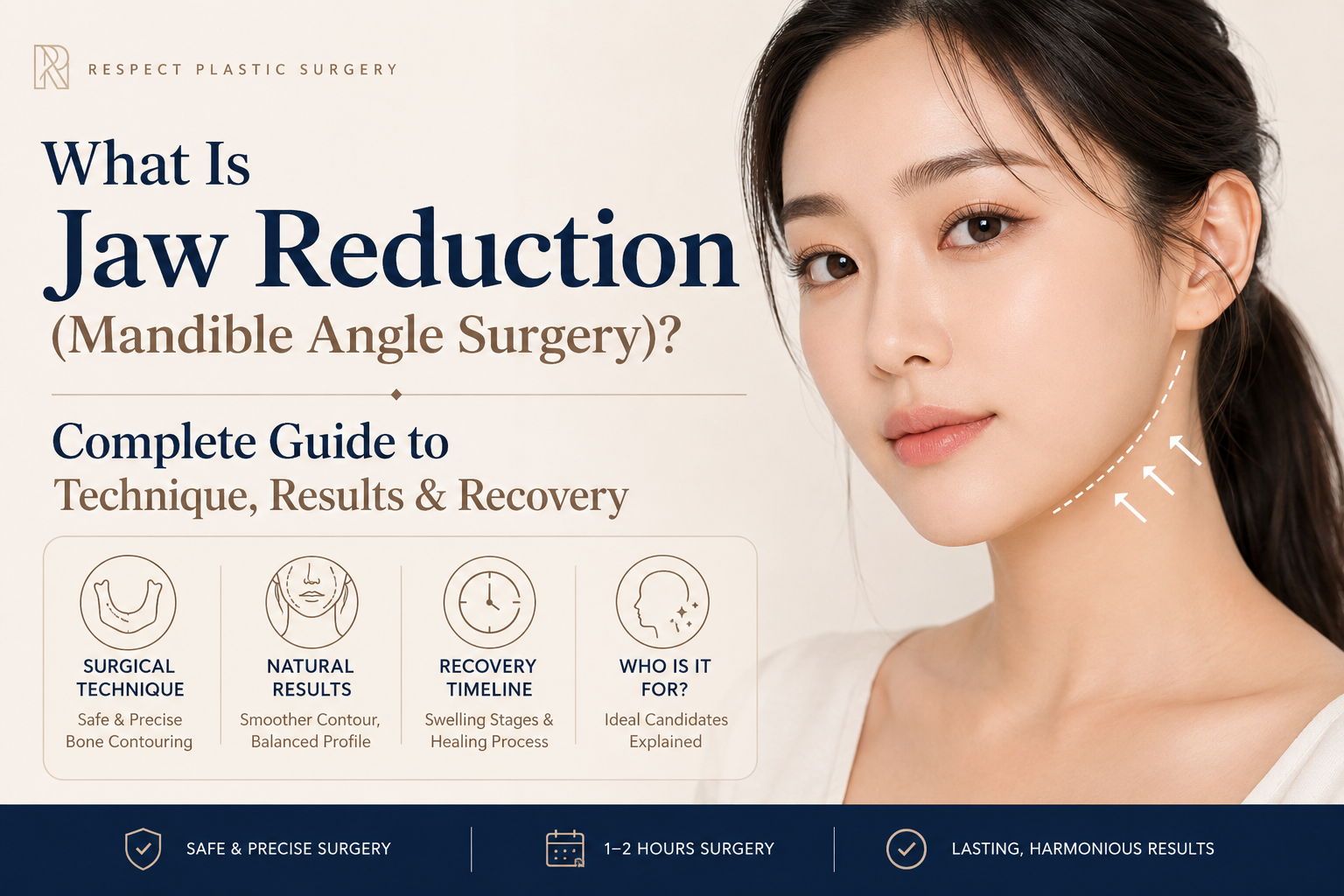
"The lower half of my face looks wide."
"My jawline looks square or box-shaped from the front."
"I want a slimmer, more refined jawline."
These concerns often trace back to a prominent jaw angle — the area extending from below the ear to the jaw.
Jaw reduction surgery removes excess bone at the jaw angle to create a smoother, more V-shaped jawline from below the ear to the chin. This procedure is also referred to as "jaw angle reduction" or "mandible angle surgery" — these terms all describe the same procedure.
This article covers how jaw reduction works, the different types of jaw concerns, the surgical technique and process, expected results, and who tends to be a good candidate.
What Is Jaw Reduction Surgery?
Jaw reduction involves cutting and removing bone at the angle of the lower jaw to refine the jawline. Unlike treatments that work on muscle (such as Botox), this procedure changes the underlying bone structure directly — which is why it can address jaw width caused by bone at a structural level.
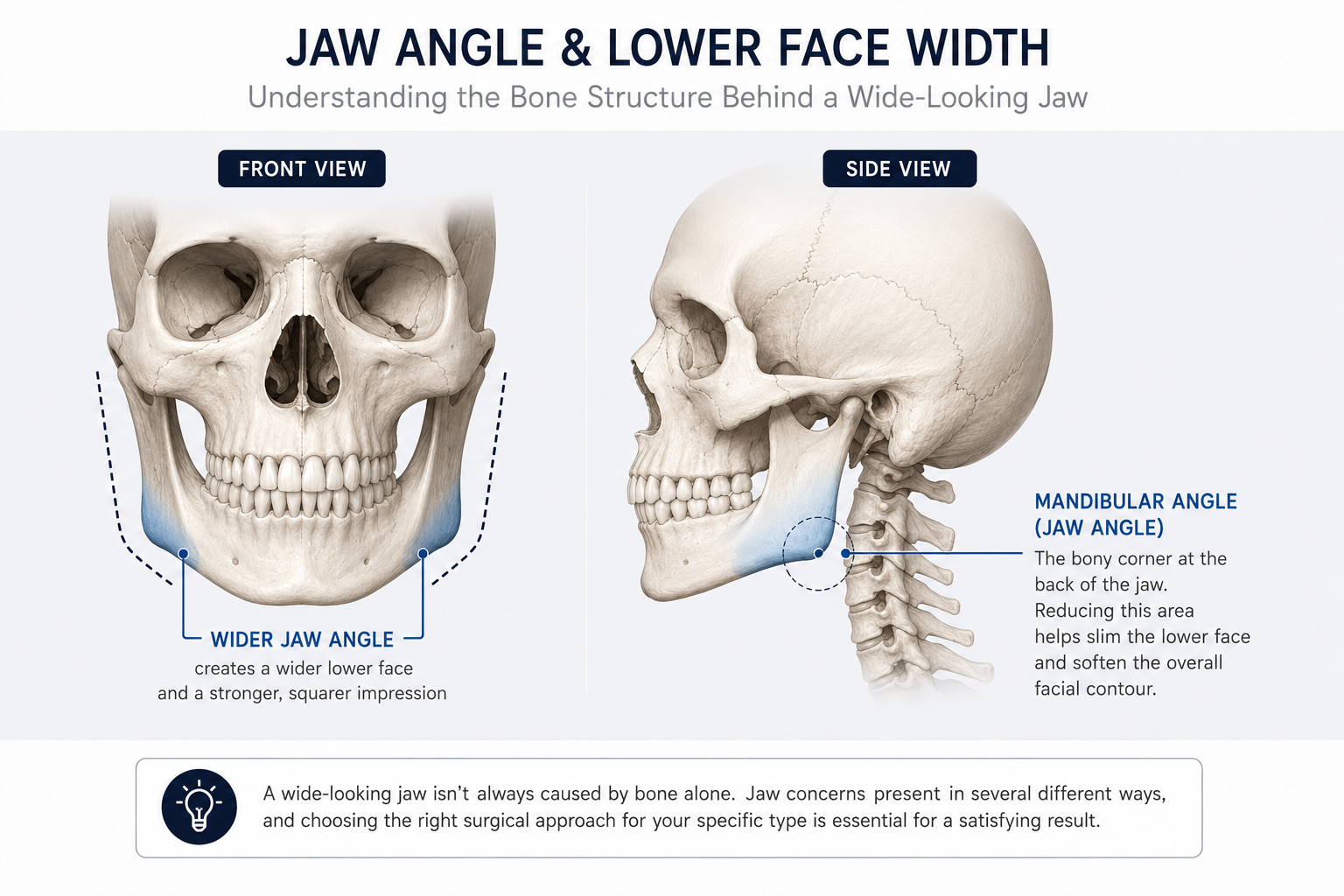
That said, it's worth noting that a wide-looking jaw isn't always caused by bone alone. Jaw concerns present in several different ways, and choosing the right surgical approach for your specific type is essential for a satisfying result.
Not All Jaw Concerns Are the Same: Common Types
What looks like "jaw width" can come from different underlying causes depending on the person:
- Overall large jaw bone: The bone itself is larger in overall size.
- Wide jaw angle span: The width between the left and right jaw angles — rather than bone thickness — is what's making the face appear wider.
- Thin bone with a protruding tip: The bone isn't necessarily thick, but the tip projects outward, creating a more angular appearance from the side or at an angle.
In addition, some cases of a wider-looking lower face are caused not by bone at all, but by an enlarged masseter muscle (the jaw muscle used in chewing) or excess buccal fat (deep cheek fat).
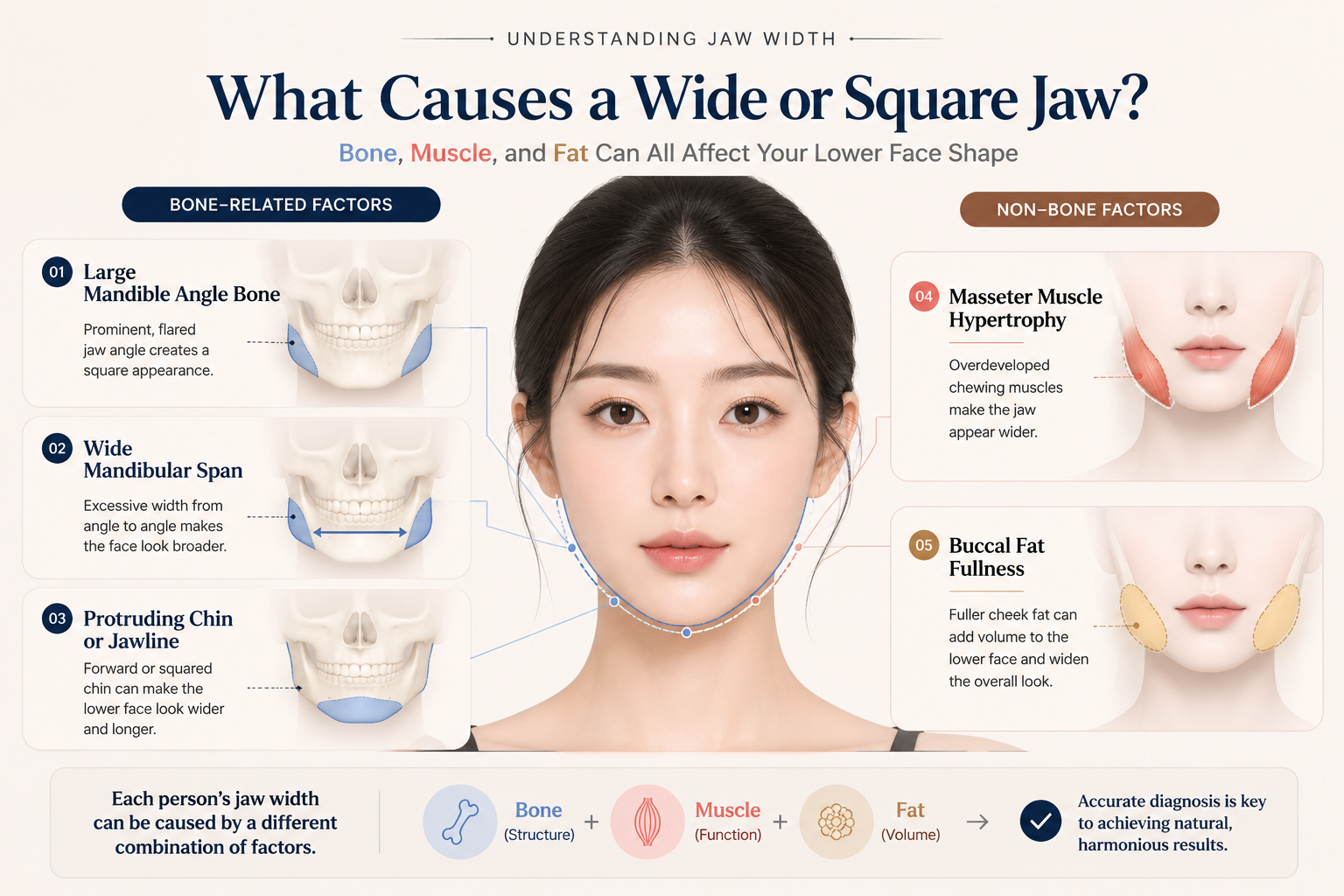
Identifying which type applies to you is the starting point for jaw surgery. At Respect Plastic Surgery, 3D CT imaging is used to evaluate not just the bone, but also muscle, fat, and skin, in order to plan a surgical approach suited to each patient.
Respect's Approach to Jaw Reduction: 4 Key Elements
① Long curved osteotomy to avoid a secondary angle
Cutting the jaw bone too conservatively can leave a new, unnatural angle at the edge of the cut (a "secondary angle"). A longer, curved cutting technique is designed to avoid this and produce a smoother jawline overall.
② Customized jaw angle adjustment
Simply removing bone isn't the goal — how much natural angle is preserved plays a major role in the final appearance. The surgical plan adjusts the jaw angle to avoid over-correction while maintaining a natural contour.
③ Combination procedures as needed
Depending on the specific concern, additional procedures may be combined — for example, cortical bone shaving (reducing the outer bone layer) when width is the main concern, or genioplasty when the goal includes shaping an overall V-line down to the chin.
④ Addressing bone, muscle, and fat together when appropriate
Depending on the case, masseter reduction and buccal fat removal may be performed alongside bone reduction. Addressing enlarged muscle or fat in addition to bone is intended to support a slimmer, smoother jawline overall.
Does Removing More Bone Produce a Better Result?
Not necessarily. What matters most in jaw reduction isn't the amount of bone removed, but the planning.
First, avoiding over-correction. Based on precise 3D imaging, the amount of bone removed should be tailored to overall facial proportions. Removing too much bone can itself lead to an unnatural appearance.
Second, correctly identifying the cause. If the concern is purely bone-related, a long curved osteotomy may address it. But if masseter muscle or buccal fat is contributing to a wider-looking face, those factors need to be addressed as well for a fully slimming result.
The Procedure Process
- Consultation and 3D CT analysis: Bone structure and soft tissue are evaluated in detail to identify the type of jaw concern.
- Surgical planning: The extent of bone removal, jaw angle design, and any combination procedures (cortical shaving, masseter reduction, buccal fat removal) are planned based on facial proportions.
- Surgery: A long curved osteotomy is performed to avoid a secondary angle.
- Recovery and follow-up: Swelling is monitored during recovery as the patient returns to daily activities.
Who May Be a Good Candidate
Patients who may want to discuss this procedure with a surgeon include those who:
- Want a slimmer jawline
- Have a wider facial structure related to jaw bone and muscle development
- Have facial asymmetry
- Have a prominent jaw angle below the ear
- Feel their lower face appears disproportionately wide
What Jaw Reduction May Improve
- A more compact, slimmer lower face: Reduced width across the lower portion of the face
- A softer, more refined impression: Less angular appearance
- Balanced from multiple angles: A refined line from both front and side views
- A smooth, continuous jawline: A natural V-line from below the ear to the chin
Individual results vary based on anatomy, technique, and healing. This content is for general education and is not a guarantee of outcome.
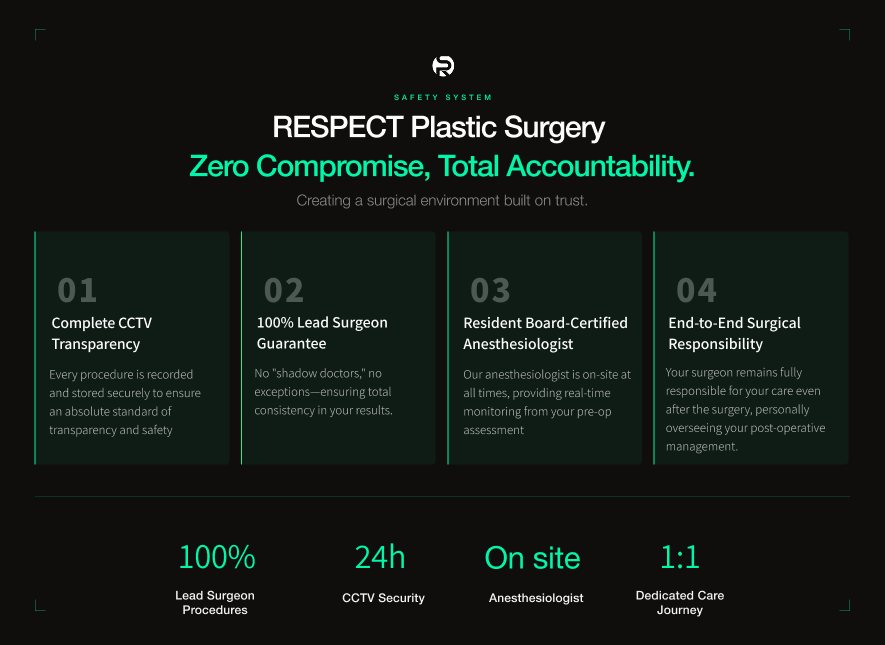
Respect's Safety System
At Respect Plastic Surgery, facial contouring procedures are overseen from start to finish by a medical team focused specifically on this type of surgery, supported by protocols designed to help patients feel confident throughout the process.
(Placeholder — replace with actual specifics, e.g., board-certified anesthesiologist-managed sedation and intraoperative monitoring, emergency response equipment and backup power systems.)
Frequently Asked Questions
Q: Is jaw reduction different from jaw angle surgery?
A: No — these are the same procedure. "Jaw reduction," "jaw angle reduction," and "mandible angle surgery" are all different names for the same surgery.
Q: Won't removing the jaw angle make my jawline look unnatural?
A: At Respect, the jaw angle is carefully adjusted during surgery to preserve a natural contour rather than removing too much. Combined with a long curved osteotomy that avoids a secondary angle, this is intended to produce a smooth result.
Q: I was told my jaw width is caused by muscle, not bone. Is jaw surgery still relevant for me?
A: The right approach depends on the underlying cause. If masseter muscle or buccal fat is contributing to the width, masseter reduction and/or buccal fat removal can be performed alongside bone reduction to support a slimmer result. A 3D CT evaluation is the first step in identifying the actual cause.
Q: Will there be visible scarring?
A: Since this procedure doesn't involve a large external incision, visible scarring on the front of the face generally isn't a concern. Specific details can be discussed during a consultation.
Summary: Jaw Reduction Is About Design, Not Just How Much Bone Is Removed
Jaw reduction (mandible angle surgery) uses a long curved osteotomy to reshape a prominent jaw angle into a smoother, more natural V-line jawline. The result depends less on how much bone is removed and more on accurately identifying your jaw concern type, planning the jaw angle carefully, and — when appropriate — addressing bone, muscle, and fat together.
If you'd like to understand whether your jaw concern is related to bone, muscle, or fat, Respect Plastic Surgery offers consultations that include 3D CT analysis to help evaluate your specific case.
As with any surgical procedure, risks such as bleeding, infection, or inflammation are possible and vary by patient. This article is intended for general informational purposes only; any recommendation for a specific procedure is made following an in-person or virtual medical evaluation.
 Google Maps