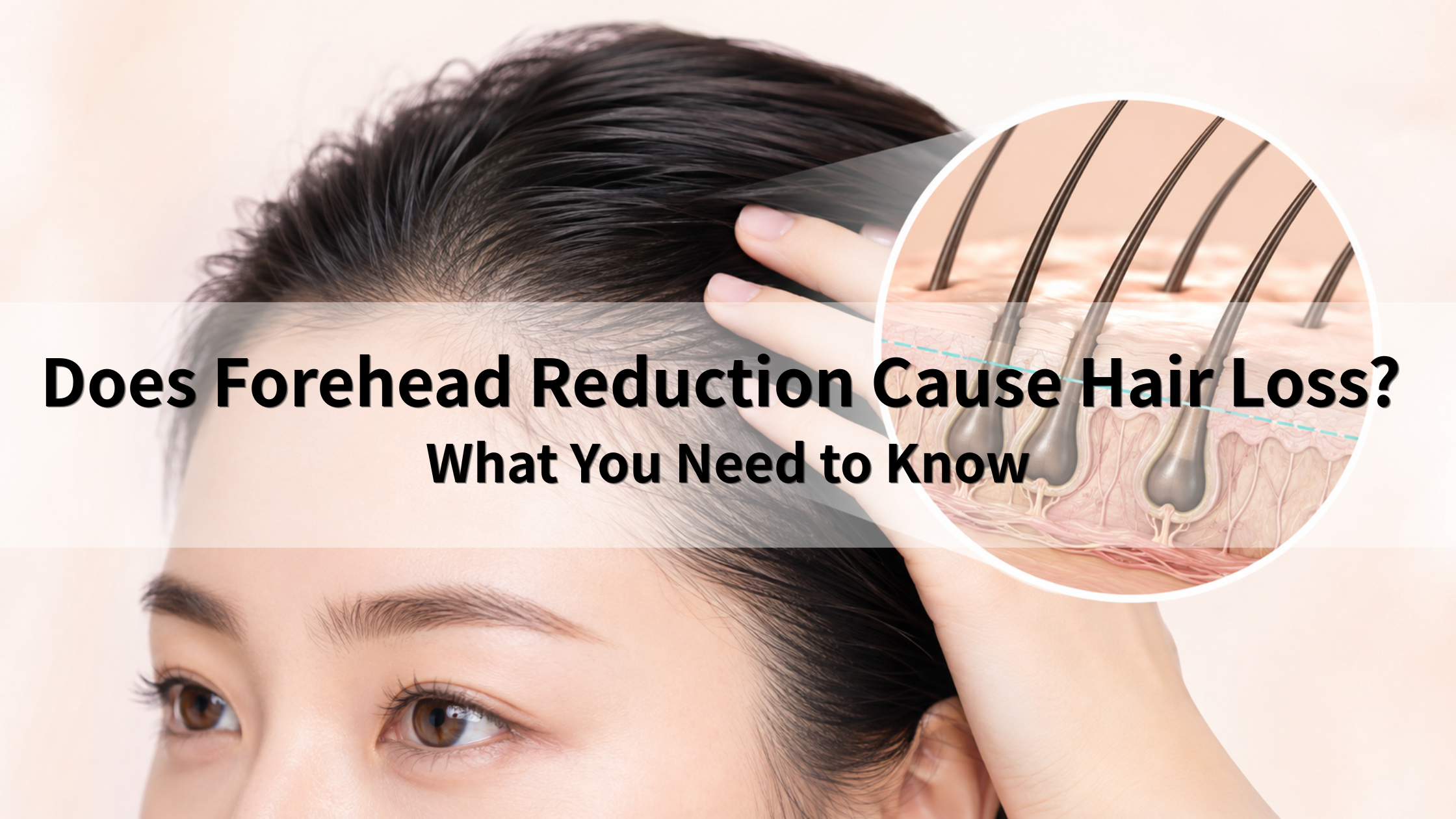
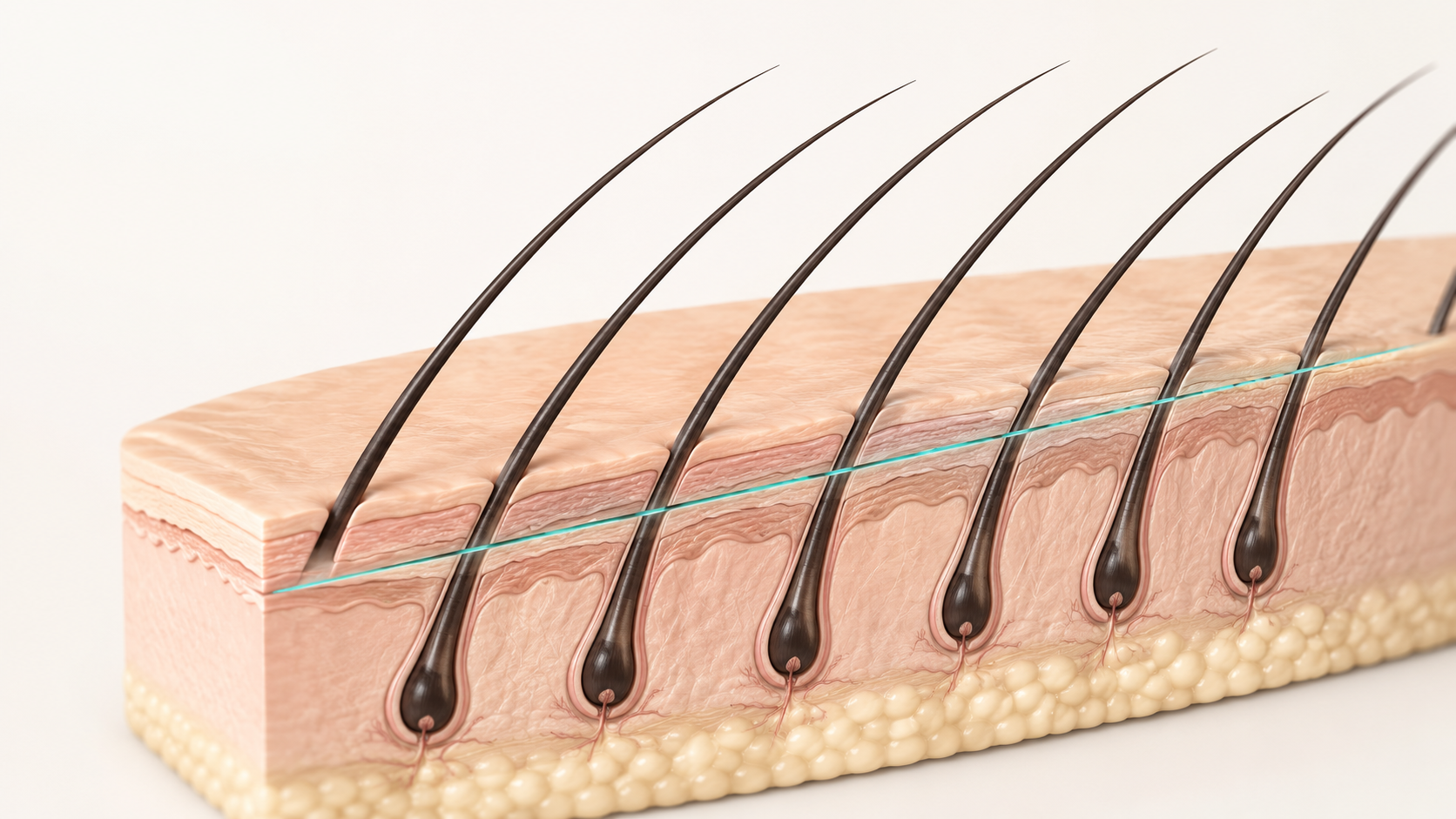
The incision line in forehead reduction runs along the hairline — right where hair roots are concentrated. That is exactly why it raises the worry that "cutting there might cause hair loss." This article breaks down the design logic behind hair root preservation, how it differs from the general phenomenon of "temporary hair shedding" after surgery, and what to watch for in post-op hair care. The information here is general; actual technique and recovery vary by individual, so always follow your physician's instructions.
Quick summary: Hair root preservation design points
Details on each point follow below.
What "Preserving Hair Roots" Actually Means
Respect's forehead reduction uses an angled incision designed around the direction hair grows.*1 Because scalp hair grows at an angle rather than straight up, aligning the incision with that angle removes tissue while reducing the risk of severing follicles outright. Hair is expected to grow naturally in front of the incision line afterward, helping the scar become less noticeable.*1 In short, "preserving hair roots" is a design choice — using incision angle and suturing precision to minimize damage — not a guarantee that follicles are never touched.
Forehead Reduction vs. the Fear of Hair Loss
Temporary hair loss after surgery (telogen effluvium) is a recognized general phenomenon linked to surgery in general, not specific to forehead reduction ✅. It is described as occurring because the hair growth cycle temporarily shifts into a resting phase from the physical stress of surgery and anesthesia — not because follicles are destroyed — and hair is described as recovering over time in most cases ✅ (individual results vary; it does not always occur). Respect's forehead reduction also uses seven or more fixation points with fine triple-layer suturing to distribute strain at the suture site.*1
Other Design Features (Facial Proportion)
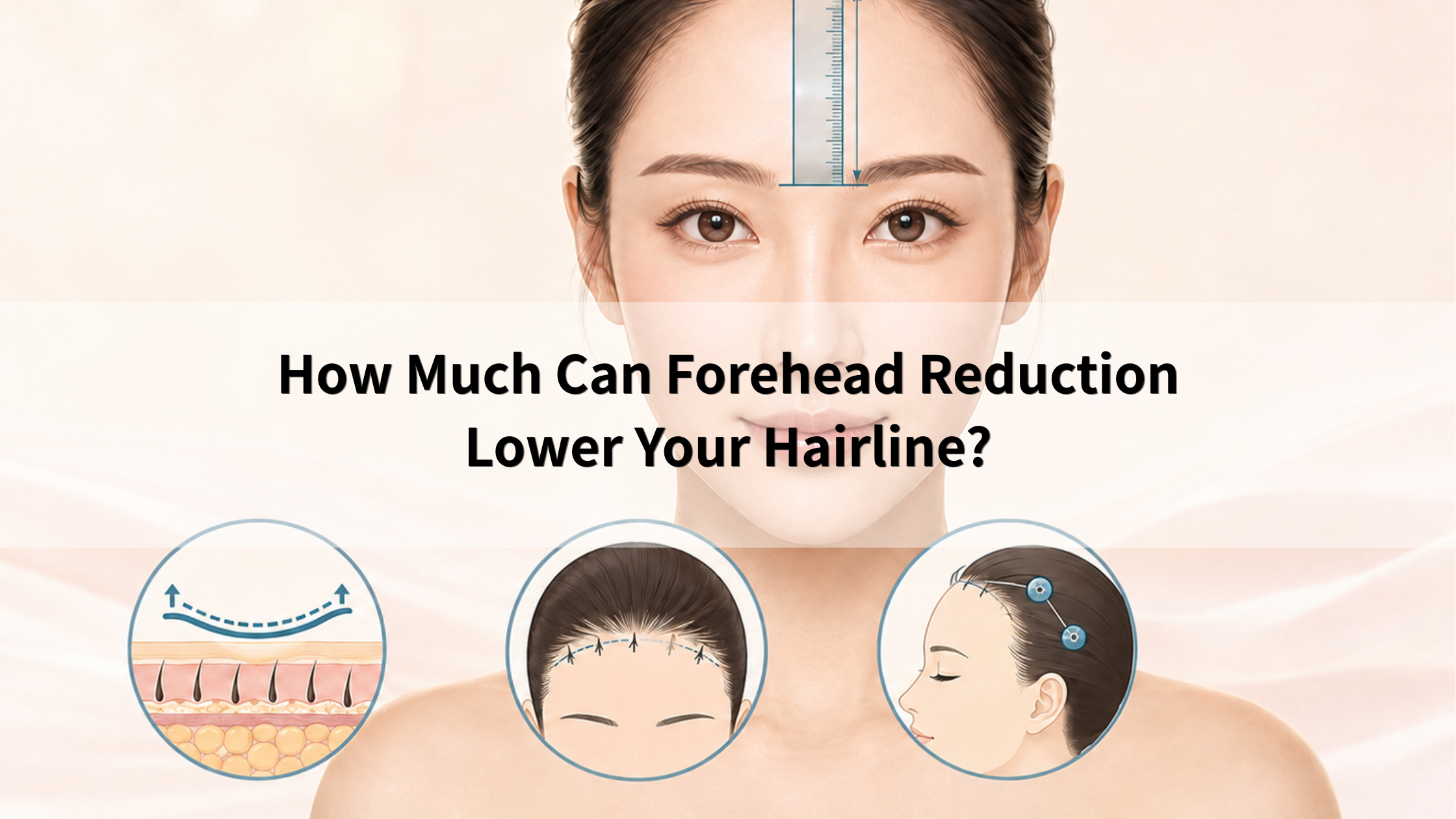
The custom design approach considers overall facial proportion, rounding the hairline while reducing the forehead.*1 As a guideline, an ideal ratio is roughly 0.9-1 from hairline to eyebrows, 1 from eyebrows to nose tip, and 0.8-0.9 from nose tip to chin.*1 The exact technique and fixation method vary by forehead width, hairline shape, and scalp elasticity, and are determined during an in-person consultation.
Post-Op Recovery and Hair Care
The suture site is described as showing mild redness for about the first month, becoming inconspicuous by around 3-6 months.*1 Because incised scalp areas are more sensitive to friction, it is generally advisable to avoid rubbing the area during the instructed period, avoid direct heat from styling tools, and consult your physician rather than self-diagnosing any concerning shedding or inflammation.
Who Should Raise This During a Consultation
Forehead reduction is described as suitable for those who want to reshape the hairline, who hide a broad forehead with bangs, who are anxious about hair transplantation, or who have a square or "M-shaped" hairline.*1 For those with thinning hair, an irregular hairline, or an ongoing hair loss condition, suitability and design may differ, so sharing your scalp condition during the consultation is essential.
FAQ
Q1. Will I lose absolutely no hair after this surgery?
A. The procedure is not built around destroying follicles — it uses an angled incision to reduce stress on hair roots.*1 Still, temporary changes are possible and vary by individual, so confirm with your physician if concerned.
Q2. What exactly is an "angled incision"?
A. It aligns the incision with the angle hair grows, reducing the risk of severing follicles while removing forehead skin.*1 Hair grows naturally in front of the line afterward, helping conceal the scar.*1
Q3. How long until the scar is inconspicuous?
A. Mild redness for about the first month, becoming inconspicuous by around 3-6 months, per Respect's official information.*1 Recovery varies by individual.
Q4. Can I have this surgery with an irregular hairline or thinning hair?
A. Square or "M-shaped" hairlines are mentioned as candidates,*1 but suitability may change depending on the degree of thinning, so a scalp assessment during consultation is necessary.
Summary | "Incision angle, fixation, don't self-diagnose"
Hair root preservation in forehead reduction comes down to three things: incision angle (following the direction hair grows), fixation (multi-point fixation that distributes load), and not self-diagnosing (confirming any concerning change during a consultation). The possibility of temporary hair loss cannot be fully ruled out, and no Respect-specific frequency or recovery data could be confirmed, so it is important to discuss your own scalp condition directly during a consultation.
If you have concerns about eligibility, design, or post-op recovery for forehead reduction, please use Respect Plastic Surgery's official LINE for an online consultation.
 Google Maps