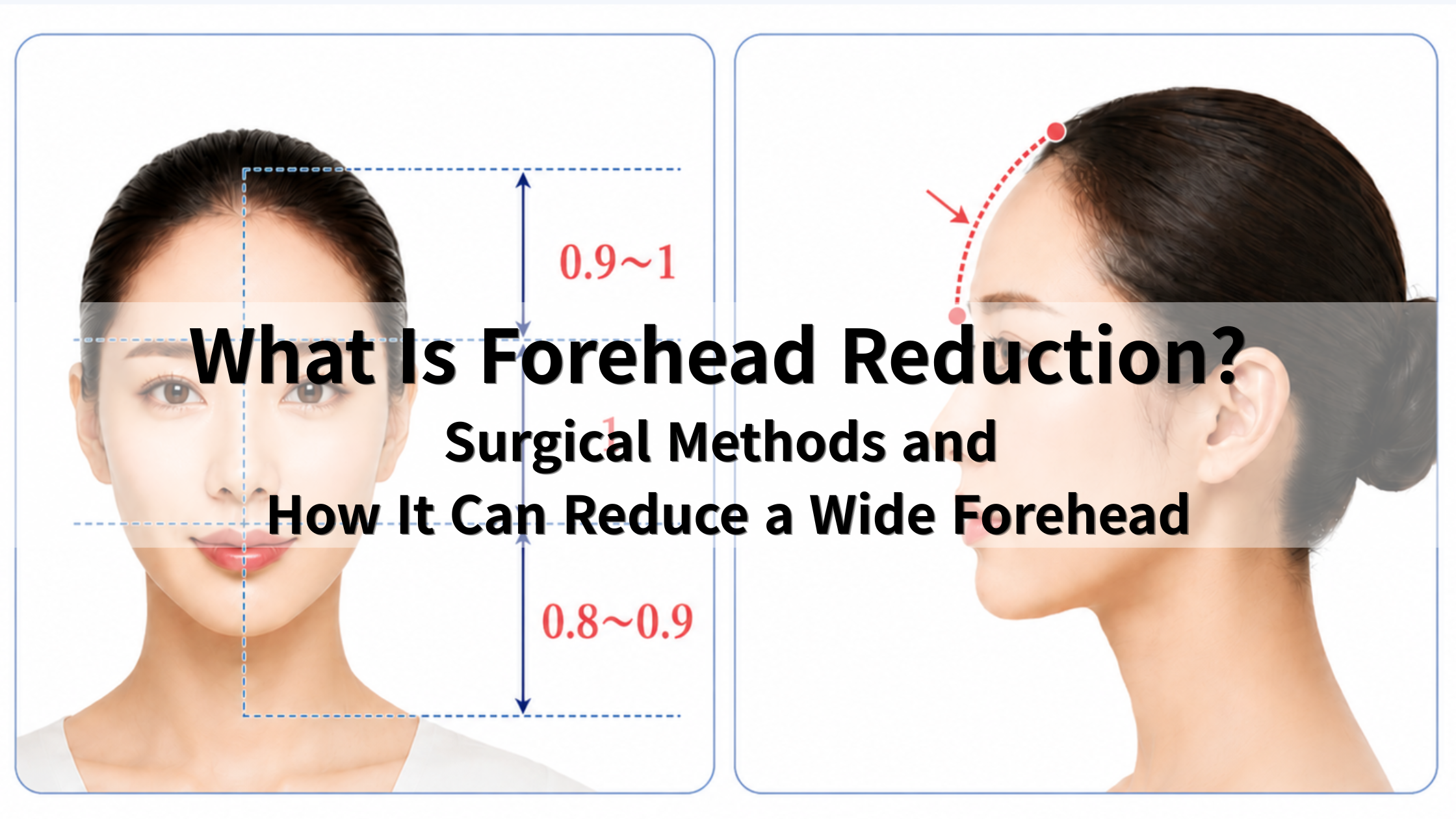
"My forehead is wide, so I always hide it with bangs." "Every time the wind blows, I worry about my hairline." "I feel like my face looks long and large." Concerns like these about a wide forehead cannot be fundamentally solved with makeup or hairstyles.
Forehead reduction is surgery that lowers the hairline to narrow a wide forehead. Because the hairline is moved forward together with the scalp, the wide forehead is filled in with your own natural front hair, and there is no need to harvest a large amount of hair, which is a key advantage.
This article explains how forehead reduction works, the full picture of the surgical method covering incision, fixation, and suturing, the ideal forehead ratio, how the scar heals, and who the procedure suits.
What Forehead Reduction Is
Forehead reduction is a procedure that makes an incision along the forehead hairline, pulls the scalp forward and down, and sutures it, thereby shortening the vertical length of the forehead.
The biggest difference from hair transplantation is that instead of grafting, the original hairline itself is lowered. There is no need to harvest a large amount of hair, and since the lowered hairline carries your own natural hair as it is, the density and natural flow of the hair are preserved.
Furthermore, at Respect Plastic Surgery, drawing on extensive experience with forehead reduction surgery, effective improvement can be achieved even in cases such as irregular hairlines or extremely wide foreheads, by applying a range of designs and surgical techniques.
The Ideal Forehead Width | One-Third of the Face
To begin with, how wide should a forehead ideally be?
When the forehead, which makes up the upper face, is too wide, the facial proportions break down and overall harmony is lost. The guideline is about one-third of the vertical length of the face. Specifically, the following ratios are considered the ideal forehead length:
Hairline to eyebrows: 0.9 to 1
Eyebrows to nasal tip: 1
Nasal tip to chin: 0.8 to 0.9
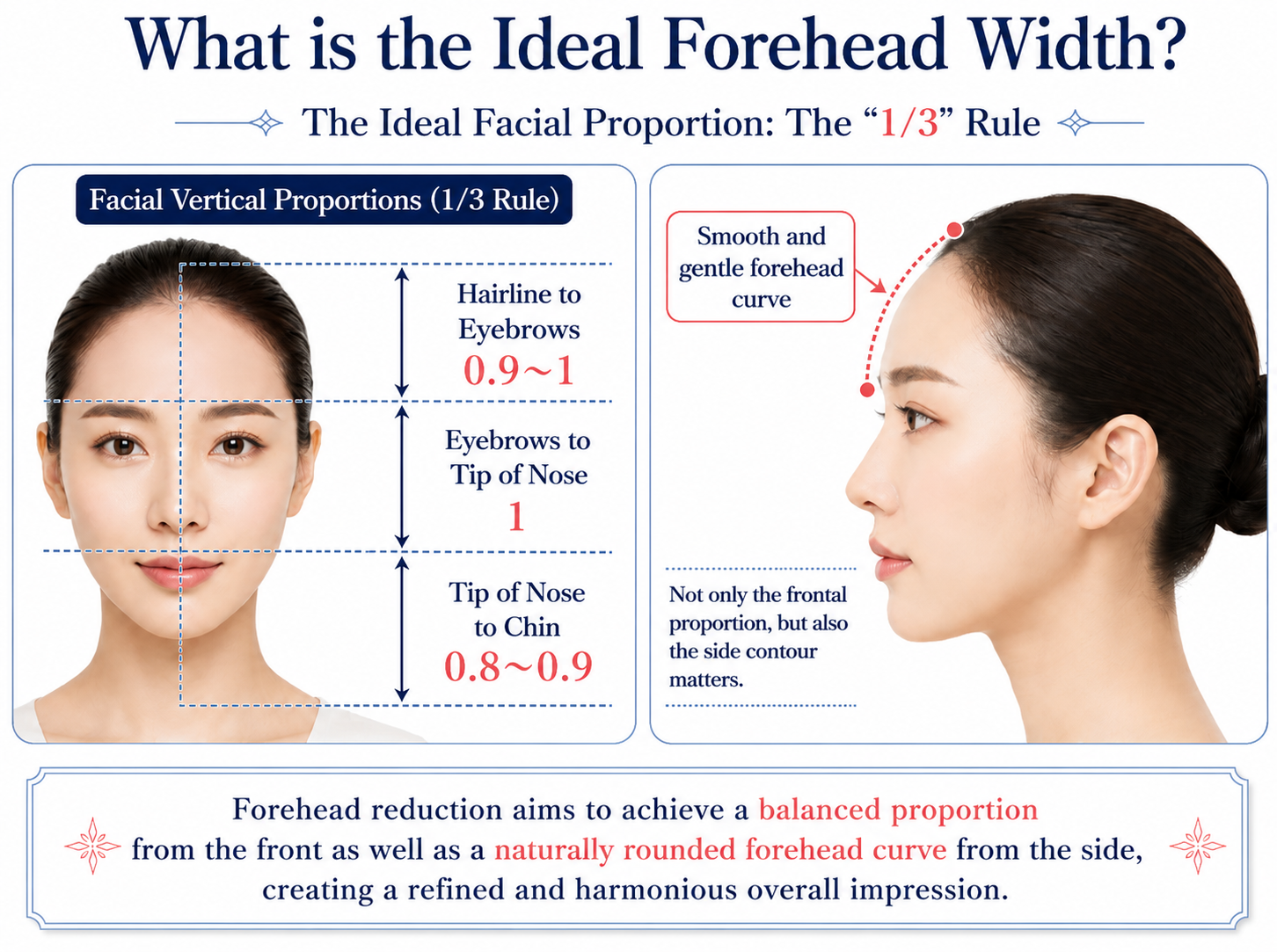
Beyond the frontal ratio, the softly rounded curve of the forehead seen from the side also matters. Forehead reduction is a procedure that creates a refined image by completing a rounded forehead curve in profile and well-proportioned ratios from the front.
The Surgical Method | The Full Picture: Incision, Fixation, Suturing
What determines the outcome of forehead reduction is where you cut, how you fix, and how you suture. Respect Plastic Surgery's forehead reduction incorporates outcome-focused refinements in each of these three steps.
1. Incision | The Beveled Incision That Preserves Hair Follicles
The hairline incision is made at an angle (a beveled incision) that takes into account the direction of hair growth, preserving the hair follicles. As a result, after surgery, hair naturally grows in front of the incision line, and the hair conceals the scar. The answer to the worry "If you cut the hairline, won't hair stop growing there?" lies in this incision design.
2. Fixation | 7-Point Fixation That Secures the Reduction Effect
Pulling the scalp down means little unless it is then firmly fixed in place. At Respect Plastic Surgery, fixation at 7 or more points is applied firmly so that the reduction effect is fully maintained. At the same time, the discomfort often associated with conventional Endotine fixation devices is minimized through this 7-point, triple-layer fixation.
3. Suturing | Fine Triple-Layer Suturing for a Minimal Scar
The finishing sutures are fine, triple-layer sutures. By carefully closing the wound in separate layers, the scar is kept minimal, which also helps shorten the recovery period.
Design | The Hairline Is Corrected into a Rounded Shape
While the wide forehead is reduced, the hairline is corrected into a rounded shape. Through customized forehead reduction that works with each person's overall facial proportions and volume, even a squared or irregular hairline can simultaneously be shaped into a soft, feminine rounded line.
How Far Can It Be Lowered? | The Key Is Scalp Elasticity
"How many centimeters can you lower it?" is one of the most common questions, but there is no single answer.
What matters is not a uniform standard, but finding the right forehead height for each person's facial proportions and scalp elasticity. Because how much the scalp stretches differs from person to person, the reduction width that suits your face is designed after considering face shape, overall image, and even face size. Rather than forcing a large reduction, adjusting to a natural height that fits your proportions is the shortcut to a refined result.
What Happens to the Scar? The Course of the Sutured Area
After surgery, the sutured area typically changes as follows:
Up to 1 month after surgery: takes on a faint red tint
After that: gradually becomes fainter
3 to 6 months after surgery: becomes inconspicuous
In addition, thanks to the beveled incision described above, hair naturally grows in front of the incision line and conceals the scar, so over time you can aim for a state where even sweeping your hair back is unlikely to be a concern.
Who Forehead Reduction Suits
This procedure is recommended for:
Those who want hairline correction at the same time as forehead reduction
Those whose forehead is wide and who always hide it with bangs
Those who want a beautiful hairline
Those who are afraid of hair transplantation, or who saw no effect even after a transplant
Women troubled by a squared or M-shaped hairline
Changes You Can Expect
A smaller forehead: approaching the ideal one-third facial ratio, bringing the whole face into better balance
Hairline correction effect: a beautifully rounded, tidy hairline
A fresh, youthful impression: confidence even with hairstyles that show the forehead
Faster recovery, faster return: a shorter recovery period thanks to fine triple-layer suturing
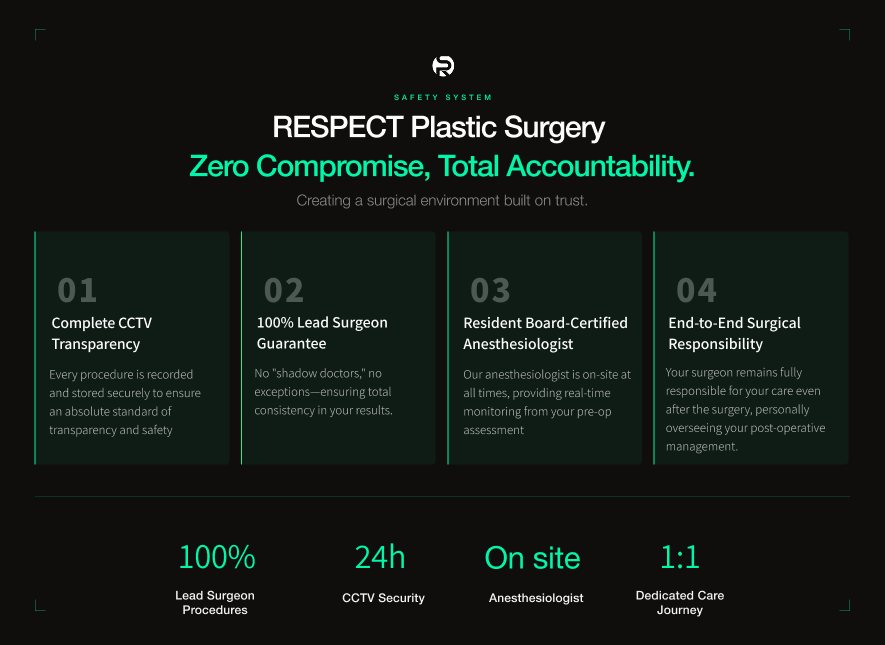
Respect Plastic Surgery's Safety System
At Respect Plastic Surgery, medical staff with extensive experience in forehead reduction surgery provide care, and systems are in place so you can undergo surgery with peace of mind.
✅ Anesthesia management and intraoperative monitoring by board-certified anesthesiologists
✅ Emergency response systems, including resuscitation equipment and backup power
Frequently Asked Questions (FAQ)
Q1. How is forehead reduction different from hair transplantation?
A. Hair transplantation harvests and grafts hair, whereas forehead reduction lowers the hairline itself. Forehead reduction requires no large-scale hair harvesting and fills the wide forehead with your natural front hair, which is its advantage. It is also chosen by those who are afraid of transplants, or who felt no effect even after a transplant.
Q2. Will hair stop growing from the scar at the hairline?
A. Because a beveled incision that takes the direction of hair growth into account preserves the hair follicles, hair naturally grows in front of the incision line after surgery and can conceal the scar.
Q3. How much can the forehead be narrowed?
A. It differs for each person, depending on scalp elasticity and facial proportions. Rather than a uniform standard, an appropriate reduction width is designed during consultation, based on the ideal one-third facial ratio and the condition of the scalp.
Q4. When does the scar become inconspicuous after surgery?
A. The sutured area takes on a faint red tint for up to 1 month after surgery, then gradually fades, becoming inconspicuous by 3 to 6 months. The pace varies by individual.
Summary | Forehead Reduction Comes Down to Careful Incision, Fixation, and Suturing
Forehead reduction is a procedure that lowers the entire hairline to narrow a wide forehead while shaping the hairline into a rounded form at the same time. What determines the outcome is the beveled incision that preserves hair follicles, the 7-point fixation that secures the reduction effect, the triple-layer suturing that keeps the scar minimal, and an individualized design based on the one-third facial ratio and each person's scalp elasticity.
If you would like to know how far your own forehead can be lowered, or what hairline would suit you, feel free to reach out through Respect Plastic Surgery's official WhatsApp for an online consultation.
Note: Complications that can generally occur after surgery, such as bleeding, infection, and inflammation, vary by individual. This article is intended to provide general information; actual suitability is determined through a medical consultation.
 Google Maps